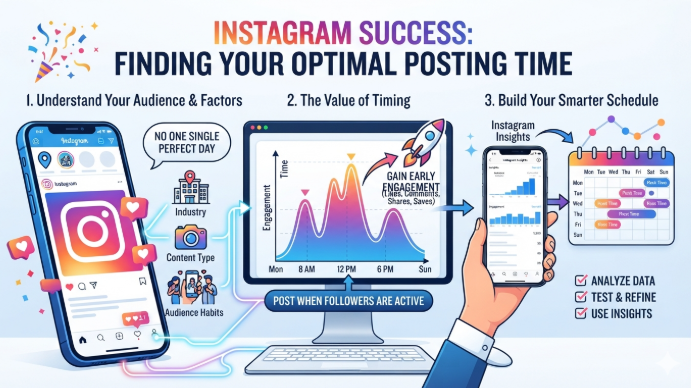
Instagram success is not only about creating great content. Timing can also affect how many people see your posts. The best day to post on Instagram can change based on your audience, location, industry, and content type. A post published when followers are active has a better chance of getting early likes, comments, shares, and saves. These early actions can help your content gain more attention. However, there is no single perfect day for every account. Your followers may use Instagram at different times. Their habits can also change during weekends, holidays, and busy seasons. This guide explains how to find the right posting schedule for your account. You will learn about weekdays, weekends, posting times, analytics, and practical testing methods. The goal is simple. You should use general timing data as a starting point. Then, use your own Instagram insights to build a smarter content schedule.
Why Posting Time Matters on Instagram
Posting time matters because Instagram users are not active all day. People usually check social media during breaks, commutes, evenings, or free time. When you publish during an active period, your followers can discover the content sooner. Early engagement can create useful momentum for a post. However, timing is only one part of Instagram growth. Strong visuals, useful captions, relevant topics, and consistent posting also matter. The best day to post on Instagram should therefore be viewed as one part of your larger strategy. Think of timing as a way to improve your starting position. It cannot make weak content successful by itself. Your goal should be to publish quality content when your target audience is most likely to be online and ready to interact.
What Is the Best Day to Post on Instagram?
For many accounts, weekdays can be strong days for Instagram engagement. Tuesday, Wednesday, and Thursday are often useful starting points. People may check social media during work breaks and after daily tasks. Monday can also perform well, especially for educational and business content. Friday can work, but audience behavior may change as people prepare for the weekend. The best day to post on Instagram depends on your followers. A fitness audience may behave differently from a travel audience. Students may be more active at night. Professionals may check Instagram during lunch breaks. Parents may browse after children go to sleep. Instead of copying one universal schedule, test several days. Compare reach, comments, shares, saves, and profile visits. This approach gives you evidence that matches your specific audience.
Best Days for Instagram Posts
| Day | General Potential | Good Content Types | Suggested Testing |
| Monday | Medium to High | Tips, motivation, business | Morning or evening |
| Tuesday | High | Educational, Reels, products | Lunch or evening |
| Wednesday | High | Reels, guides, lifestyle | Lunch or evening |
| Thursday | High | Stories, products, Reels | Afternoon or evening |
| Friday | Medium to High | Entertainment, lifestyle | Afternoon |
| Saturday | Medium | Travel, lifestyle, entertainment | Morning or evening |
| Sunday | Medium | Inspiration, planning, lifestyle | Evening |
These recommendations are starting points rather than fixed rules. Your Instagram analytics should guide your final schedule.
Best Time to Post on Instagram
The ideal posting hour depends on when your followers are online. Morning periods can work because people often check their phones after waking up. Lunch hours may also create opportunities when users take breaks. Evening periods can be strong because people have more free time. However, you should avoid assuming that one hour works for every audience. The best day to post on Instagram and the best hour should be tested together. For example, compare Tuesday at noon with Tuesday at 7 PM. Track the results over several weeks. Look beyond likes. Reach, shares, saves, comments, and profile activity can provide stronger signals. A post with fewer likes may still be valuable if it produces more saves or website visits. Your objective should determine which metric matters most.
Best Instagram Posting Schedule by Day
A simple schedule can help you organize your content. You could begin by testing Tuesday, Wednesday, and Thursday. Publish important content during different time windows. For example, try a morning post on Tuesday, an afternoon post on Wednesday, and an evening post on Thursday. This gives you useful comparison points. Do not change too many variables at once. If you change the topic, format, day, and time together, results become harder to understand. The best day to post on Instagram becomes clearer when your testing process stays consistent. Keep similar content formats during your experiments. After several weeks, identify the strongest patterns. You can then focus your main posts around those periods. Continue testing because audience behavior can change over time.
How Instagram Insights Can Find Your Best Day
Instagram Insights is one of the most useful tools for improving your posting schedule. Professional accounts can review information about their audience and content performance. Look for periods when your followers are most active. Then compare those periods with your post results. Do not rely on follower activity alone. A large active audience does not automatically mean strong engagement. Check how posts perform after publication. Look at reach, engagement, shares, saves, comments, and profile actions. The best day to post on Instagram for your account should come from these combined signals. Keep notes about your experiments. Record the date, time, format, topic, reach, and engagement. After several weeks, patterns should become easier to see. This turns posting decisions from guesses into a repeatable process.
Does Your Industry Change the Best Posting Day?
Yes, audience behavior can vary greatly between industries. A restaurant may perform well before meal times. A fitness creator may receive more attention before or after common workout hours. A business account may attract users during weekday breaks. A fashion account may perform well during shopping periods. Travel content can behave differently during weekends and holidays. Because of these differences, the best day to post on Instagram should reflect your audience’s routine. Study who follows you and why they use your content. Ask yourself when they have time to browse. Also consider their location and time zone. If your followers live in different countries, one posting time may not reach everyone equally. Use audience data to identify your largest groups. Then build a schedule around the most important audience segments.
How Time Zones Affect Instagram Engagement
Time zones can make Instagram scheduling more difficult. Your audience may live in several cities, countries, or regions. Posting at 9 AM in one location may mean afternoon or evening elsewhere. This can change your results significantly. Start by identifying where most of your followers live. Then choose posting windows that overlap with their active periods. If your audience is split between two major regions, consider testing different schedules. You may also use different content formats at different times. For example, publish a main post for your largest audience. Later, use Stories to engage another region. The best day to post on Instagram may also differ between audience groups. A data-based approach helps you avoid choosing a schedule based only on your own routine.
Weekdays vs. Weekends on Instagram
Weekdays and weekends often create different user habits. During weekdays, people may check Instagram during breaks, lunch, and evening downtime. Weekends can provide more free time, but people may spend that time outdoors, traveling, shopping, or socializing. This can make engagement less predictable. Still, weekend posts can perform very well for specific audiences. Lifestyle, food, travel, entertainment, and personal content may fit weekend behavior naturally. The best day to post on Instagram should therefore depend on your content and audience. Do not remove weekends from your strategy without testing them. Try similar posts on a weekday and weekend. Compare the results using the same key metrics. This gives you a clearer picture of how your followers behave. You may discover that your audience prefers a schedule different from general industry recommendations.
Reels, Stories, and Feed Posts Need Different Timing
Different Instagram formats can produce different engagement patterns. Reels are designed for discovery and can reach people beyond your existing followers. Feed posts may depend more heavily on your current community. Stories are often useful for frequent, casual interactions. Because each format has a different purpose, timing should match your goal. If you want discovery, test Reels during periods when your audience is active. If you want replies, use Stories when followers are likely to check their phones. The best day to post on Instagram may therefore differ by format. Track each format separately. Do not compare a Reel directly with a photo and assume the better result came only from timing. Content quality, format, topic, and audience intent all influence performance. A separate testing plan makes your data much more useful.
How Often Should You Post on Instagram?
Consistency is usually more useful than posting randomly. You do not need to publish many times each day to build an audience. Instead, create a schedule you can maintain. For some accounts, several feed posts per week may be realistic. Stories can be used more frequently for ongoing engagement. Reels can be added based on your production capacity. The best day to post on Instagram is less useful if you cannot maintain a consistent content plan. Quality should remain a priority. Plan content around your audience’s questions, interests, and problems. Create a simple calendar with topics and formats. Then use your performance data to adjust the schedule. Over time, consistency helps you understand your audience better. It also gives you more data for future posting decisions.
Common Instagram Posting Mistakes to Avoid
One common mistake is copying another account’s posting schedule. Their audience may live in different locations or have different habits. Another mistake is judging performance too quickly. A post may continue reaching users after publication. Avoid changing your schedule after only one or two posts. You need enough data to identify meaningful patterns. Another mistake is focusing only on likes. Shares, saves, comments, reach, and profile actions can tell a deeper story. Some creators also post without considering content quality. Timing cannot fix an unhelpful or uninteresting post. The best day to post on Instagram should support strong content rather than replace it. Build useful posts first. Then use timing, testing, and analytics to improve their chances of reaching the right audience.
A Simple 30-Day Instagram Timing Test
A 30-day test can help you find useful patterns. Start with three posting days each week. Choose Tuesday, Wednesday, and Thursday as your initial test days. Use different time windows across those days. Keep your content quality and format reasonably consistent. Record reach, likes, comments, shares, saves, and profile visits. At the end of each week, review the results. Avoid making major decisions from one unusually successful post. After four weeks, compare the average performance for each day and time. The best day to post on Instagram should be the period that repeatedly produces useful results. You can then build your regular calendar around the strongest periods. Repeat the test every few months. Audience behavior changes, so your best schedule may change too.
How to Build a Better Instagram Content Calendar
A good content calendar makes timing easier. Start by listing your main content categories. These could include education, entertainment, products, customer stories, and behind-the-scenes posts. Next, assign each category to a suitable day. Leave room for current trends and important events. Add your planned posting times based on your testing results. Your calendar should remain flexible. If a major event changes audience behavior, adjust your plan. The best day to post on Instagram should never become a rigid rule. Your analytics should remain the final guide. Review your calendar each month. Remove weak content ideas and repeat topics that produce meaningful engagement. Also track which captions, hooks, and visual styles perform well. Combining timing data with content insights can create a much stronger Instagram strategy.
Frequently Asked Questions
What is the best day to post on Instagram?
Tuesday, Wednesday, and Thursday are useful starting points for many accounts. However, there is no universal winner. Your audience location, industry, and behavior matter. Use Instagram Insights to find when your followers are active. Then test several days and compare actual results. Your personal data should eventually guide your posting calendar.
Is Monday a good day to post on Instagram?
Monday can be a good day for many accounts. People often return to normal routines after the weekend. Educational, motivational, business, and planning content can fit this behavior. Test Monday against Tuesday and Wednesday. Look at reach and engagement rather than relying only on likes.
Is it better to post on weekdays or weekends?
Neither option is always better. Weekdays may work well for professional audiences. Weekends can work well for lifestyle and entertainment content. Your audience’s habits matter most. Test similar content during both periods. Compare the average results over several weeks.
What is the best time to post on Instagram?
There is no single best hour for every account. Morning, lunch, and evening periods can all work. Check when your followers are active through Instagram Insights. Then test several time windows. Choose the periods that consistently produce strong engagement and reach.
Does posting every day increase Instagram reach?
Posting every day does not automatically guarantee higher reach. Content quality and audience interest remain important. A smaller number of useful posts can outperform frequent weak content. Choose a schedule you can maintain. Use analytics to decide whether increasing or reducing frequency helps your account.
How can I find my personal best posting schedule?
Start with Instagram Insights and review follower activity. Choose several days and time windows for testing. Track reach, comments, shares, saves, and profile actions. Run the test for several weeks. Then compare average performance. Repeat the process regularly because audience behavior can change.
Conclusion
Finding the best day to post on Instagram is easier when you combine general guidance with your own data. Tuesday, Wednesday, and Thursday are useful starting points. However, your audience may have completely different habits. Consider their location, lifestyle, industry, and content interests. Test morning, afternoon, and evening periods. Track more than likes. Reach, saves, shares, comments, and profile visits can reveal stronger patterns. Keep your content helpful, clear, and consistent. Then adjust your schedule based on real performance. Remember that timing supports good content. It does not replace it. The smartest approach is to treat your posting schedule as an ongoing experiment. Test, measure, learn, and improve. With consistent tracking, you can create a posting calendar that fits your audience instead of relying on generic advice.